How to Sync Google Calendar with Outlook (One-Way or Two-Way)
Work runs on Outlook, personal life on Google Calendar. Compare ICS subscriptions, manual blocking, and two-way sync tools to keep both calendars aligned — without exposing event details from one side to the other.
Your company runs on Microsoft 365 and Outlook. Your personal life — and maybe a side business — lives in Google Calendar. This split is extremely common, and it creates one simple problem: whenever you book time while looking at only one calendar, you risk colliding with the other.
A slot that looks free in Outlook may hold a personal appointment. A client call booked from Google Calendar may land on top of an internal meeting that only exists in Outlook.
The short answer: the simplest reliable way to keep a personal Google Calendar and a work Outlook calendar in sync — without exposing event details from one side to the other — is a calendar sync tool that creates real “busy-only” events on the other calendar. Built-in ICS subscriptions are free but refresh slowly, and because subscribed events never become real events on your primary calendar, the free/busy status that Microsoft 365 coworkers, rooms, and most booking tools check still shows you as available (booking features that can read subscribed calendars, such as Google Calendar appointment schedules on eligible plans, are the exception). Manual copying works only at very low volume. A sync tool mirrors each event as a detail-free busy block, updates it when the original changes, and removes it on cancellation, so both calendars stay accurate and private.
This article walks through the practical ways to keep Outlook and Google Calendar aligned, from what the built-in features can do to where a dedicated sync tool becomes necessary.
Option 1: Subscribe to each other via ICS links
Both Outlook and Google Calendar support publishing and subscribing to calendars in the iCalendar (ICS) format.
- In Outlook on the web, you can publish a calendar from settings and get an ICS link
- In Google Calendar, use “Other calendars” → “From URL” to subscribe to that link
- The reverse direction works the same way: add your Google Calendar’s ICS address to Outlook
This costs nothing, and if you only need to see both sets of events side by side, it may be enough.
But ICS subscriptions come with hard limitations:
- Slow refresh. Subscribed calendars can take hours — sometimes a day or more — to update, so last-minute changes don’t come through in time
- Read-only. Subscribed events are display-only overlays; they don’t become events on your own calendar
- Invisible to most availability checks. Room booking, coworkers checking your free/busy status, and scheduling tools that read your actual Outlook or Google calendar don’t see overlay events — you still look “free”. Booking features that can include subscribed calendars in availability, such as Google Calendar appointment schedules on eligible plans, are the exception; Microsoft 365 free/busy is not among them
- Link management. Anyone with the ICS URL can read the calendar, so the link itself needs care
ICS subscriptions help you avoid overlooking events. They do nothing when other people or systems are the ones checking your calendar.
Option 2: Manually copy “busy” blocks
The manual approach: for each event on one calendar, create a matching “Busy” block on the other. It hides the details while blocking the time.
With a handful of events per month this works. Beyond that, missed copies, unsynced reschedules, and forgotten deletions are inevitable. We’ve covered why manual copying breaks down in How to Auto-Copy Google Calendar Events to Another Calendar.
Option 3: Use a sync tool that creates real events
If you need fast propagation and — critically — events that count in availability checks, the practical answer is a calendar sync tool that creates real events across Outlook and Google Calendar.
A sync tool watches the source calendar and automatically creates, updates, and deletes corresponding events on the destination calendar. Because the destination gets real events:
- Outlook-side availability (coworkers, room booking, meeting requests) reflects your personal commitments
- Google-side booking pages and scheduling tools see your work meetings
- Reschedules and cancellations follow automatically
Most tools also let you sync as “Busy” only, so the destination calendar blocks the time without exposing event titles or details.
Syncing Outlook and Google Calendar with Chronock
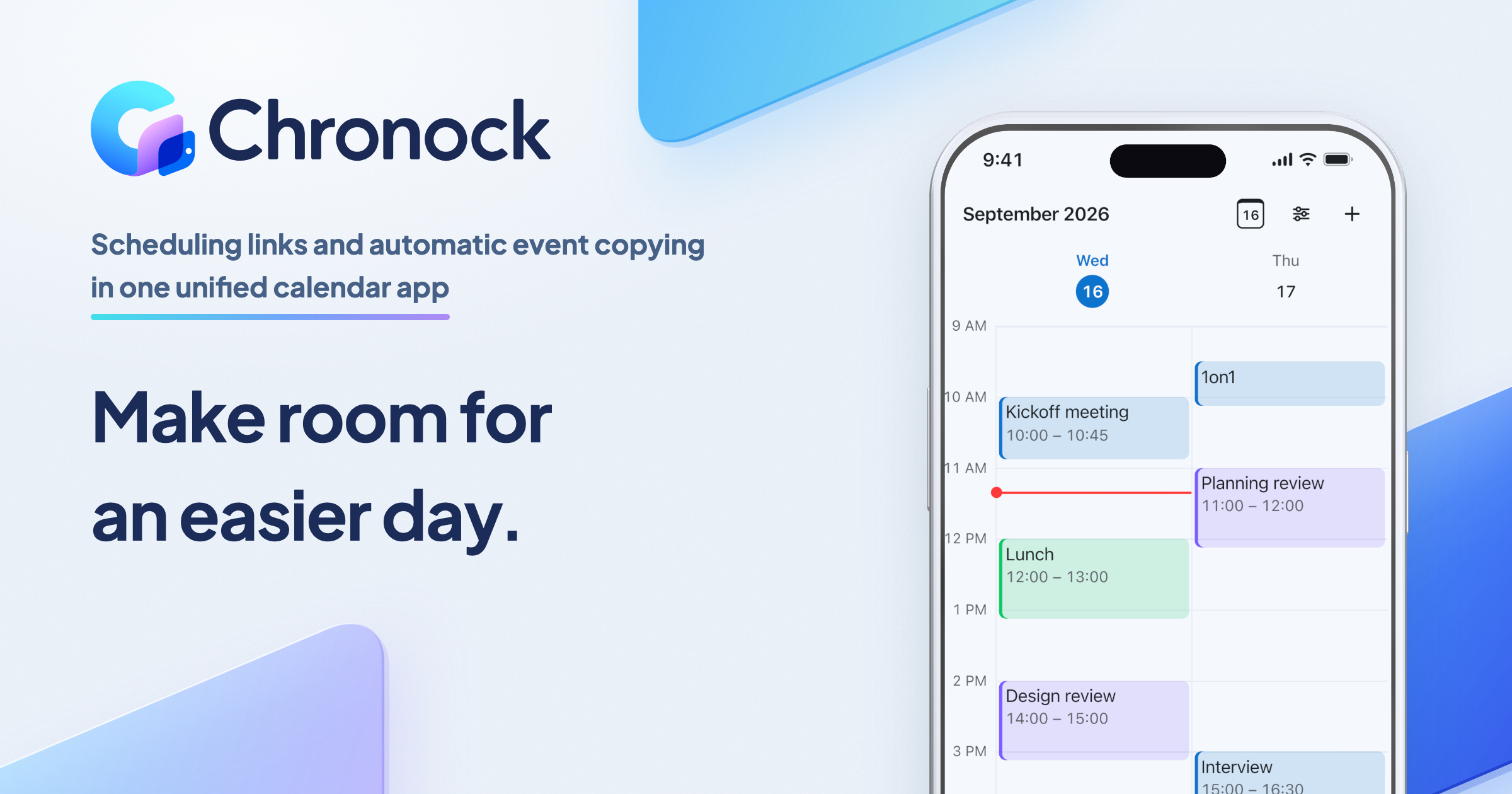
Chronock, an integrated calendar with scheduling and calendar sync built in, supports Microsoft Outlook calendars alongside Google Calendar. You can create sync rules between Outlook calendars, between Google calendars, and — most usefully for this setup — across Outlook and Google Calendar.
| Goal | Setup in Chronock |
|---|---|
| Block work Outlook time with personal Google events | One-way sync from Google Calendar to Outlook, busy-only |
| Include work meetings in a side-business booking page | Connect the Outlook calendar and include it in availability detection |
| Keep both calendars fully aligned | Bidirectional Outlook ↔ Google sync (Pro) |
| See both calendars in one place, and add events to either | Chronock’s integrated calendar shows connected Outlook and Google calendars in one day, week, or month view, with event creation and editing |
Beyond sync, Chronock evaluates availability across all connected Outlook and Google calendars for booking pages and candidate-time suggestions.
The Free plan includes up to 2 connected calendars across Google and Outlook, cross-calendar availability detection, and one one-way, busy-only sync rule. Multiple rules, bidirectional sync, and title/description copying are part of the Pro plan (7-day free trial). Pro supports unlimited calendar connections.
Which Microsoft accounts work
One important caveat: Chronock’s Outlook integration works with Microsoft 365 work or school accounts (business plans such as Microsoft 365 Business).
Personal Microsoft accounts — Outlook.com or Hotmail addresses — are not supported. This isn’t a Chronock-specific restriction: the Microsoft Graph API used for free/busy availability is not available for personal accounts, so most scheduling and sync tools share the same limitation.
- Company-issued Microsoft 365 account (you@yourcompany.com): supported
- Personal Outlook.com / Hotmail account: not supported
If your personal events live in Outlook.com, consider consolidating personal scheduling into Google Calendar and connecting on the Google side.
Which option should you choose?
| Situation | Start with |
|---|---|
| You just need to see both calendars yourself | Mutual ICS subscriptions, or an integrated calendar with both connected |
| Only a few events per month need blocking | Manual busy blocks |
| Availability checks on either side must reflect both calendars | A sync tool that creates real events |
| Time must be blocked without exposing details | Busy-only sync rules |
If you live in both Outlook and Google Calendar daily, view-only ICS subscriptions stop being enough sooner than you’d expect. Setting up automatic sync for the time slots that must never collide is worth doing early.