How to Create a Scheduling Link in Outlook (3 Ways)
Share an Outlook link that lets people book time with you: Microsoft Bookings, Scheduling Poll, or a booking page that also checks your Google Calendar.
“Could you send over a few times that work for you?” — if your company runs on Microsoft 365, you’ve probably typed candidate times into an email while squinting at your Outlook calendar more times than you can count.
Scheduling tools for Google Calendar users are everywhere, but the options for turning an Outlook calendar into a scheduling link are less clearly mapped out. This article covers what Microsoft 365 offers out of the box, and when a third-party tool makes more sense.
Option 1: Microsoft Bookings / personal booking pages
Many Microsoft 365 business plans include Microsoft Bookings, a built-in appointment booking feature.
Bookings comes in two shapes:
- Shared booking pages: a team-level page with services, staff, and business hours — the shape used by support desks and service businesses
- Personal booking pages (“Bookings with me”): a one-on-one page driven by your own Outlook calendar’s availability
Both are wired into the Outlook calendar, and confirmed bookings land on it automatically. If your plan includes it, there’s no extra cost — which makes it the natural first thing to check.
The caveats:
- Availability depends on your plan and admin settings (some organizations disable it)
- Free/busy detection generally covers calendars inside your Microsoft 365 tenant — personal Google calendars or calendars in another tenant aren’t considered
- Page and menu customization is limited compared to dedicated tools
If your scheduling lives entirely inside the company’s Microsoft 365, start with Bookings.
Option 2: Voting-based scheduling (Scheduling Poll)
Outlook also includes Scheduling Poll (formerly FindTime), which lets you propose several candidate times and have attendees vote. Once everyone responds, the meeting can be confirmed automatically.
For multi-attendee meetings that mix internal and external participants, voting often fits better than a booking page. But it’s a poll, not a booking page — the other person picks from your pre-selected candidates rather than browsing your open slots. For sales calls or interviews where the other party should choose freely, it’s not the right shape.
Option 3: A scheduling tool that connects to Outlook
A third-party scheduling tool becomes worth considering when requirements like these appear:
- Availability should reflect both your work Outlook calendar and a personal Google calendar
- You want separate booking links per purpose (sales, interviews, consultations)
- You want booking history and contact management in the same place
- You also want calendar-to-calendar event sync handled by the same tool
Creating a booking page from Outlook with Chronock
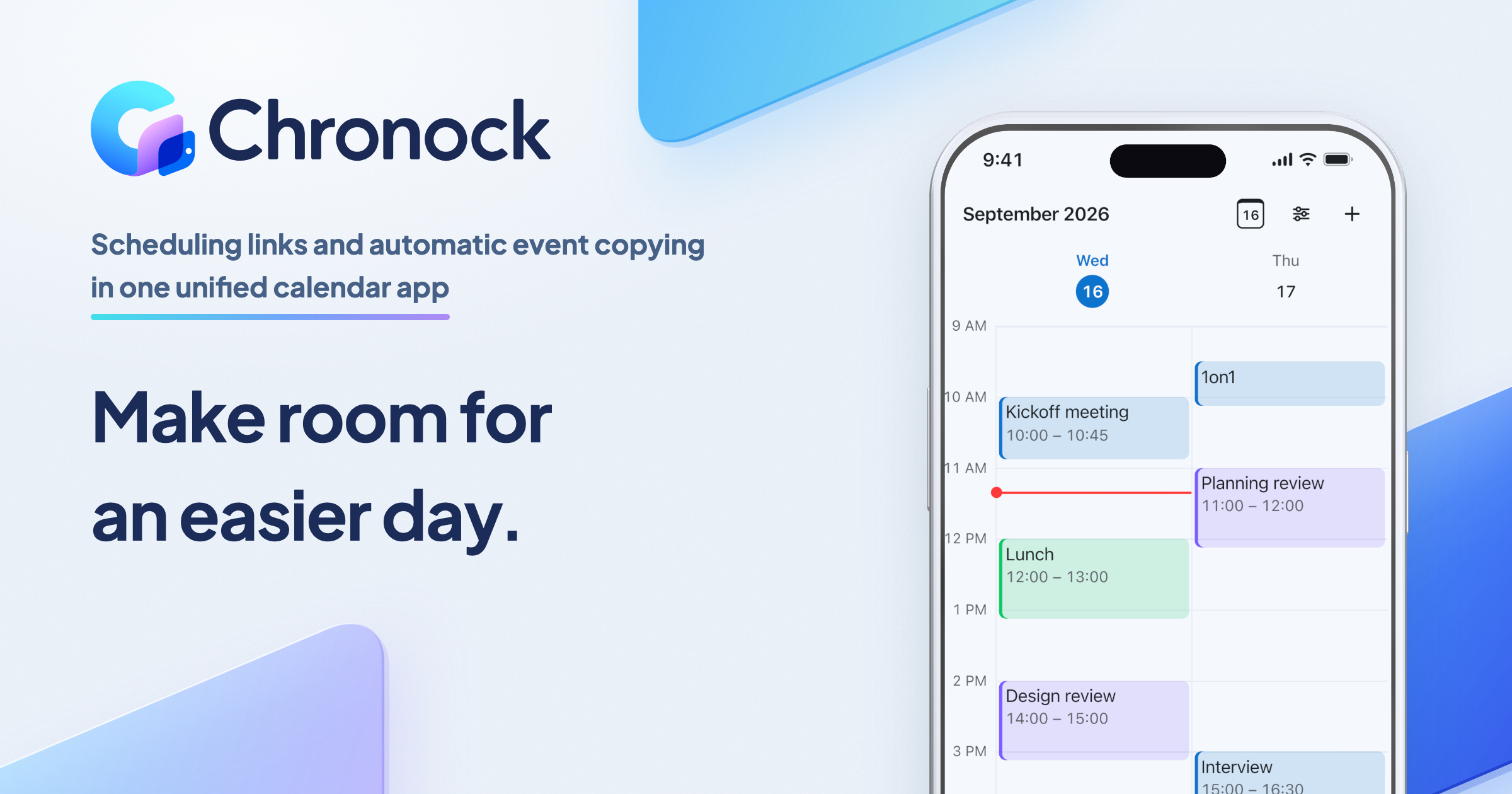
Chronock, an integrated calendar with scheduling and calendar sync built in, connects to both Google Calendar and Microsoft Outlook calendars.
With an Outlook calendar connected, you can:
| Goal | How it works in Chronock |
|---|---|
| Show only your Outlook free slots on a booking page | Connect the Outlook calendar and include it in availability detection |
| Combine work Outlook + personal Google Calendar | Connect both; availability is evaluated across all events |
| Paste candidate times into an email | Generate copy-ready candidate times from your availability |
| Keep Outlook and Google Calendar aligned | Create cross-calendar sync rules (more here) |
| See Outlook and Google events in one place | The integrated calendar shows both in one day, week, or month view, with event creation and editing |
Confirmed bookings are added to your calendar automatically, with Google Meet and Zoom links generated for online meetings.
The key difference from Bookings: Chronock isn’t confined to Microsoft 365. If your work calendar is Outlook and your personal or side-business calendar is Google, one booking page can evaluate availability across both.
Which Microsoft accounts work
Chronock’s Outlook integration works with Microsoft 365 work or school accounts (business plans such as Microsoft 365 Business).
Personal Microsoft accounts (Outlook.com, Hotmail) are not supported — the Microsoft Graph API used for free/busy availability isn’t available for personal accounts, a constraint shared by most scheduling tools.
Which option should you choose?
| Situation | Start with |
|---|---|
| Everything lives inside Microsoft 365, and you want zero extra cost | Microsoft Bookings / personal booking page |
| A group meeting needs a vote on candidate times | Scheduling Poll |
| Availability must span Outlook and Google Calendar | A scheduling tool with Outlook support |
| You need per-purpose booking links plus booking history | A scheduling tool with Outlook support |
Check the built-in features first. The moment your calendars extend beyond Microsoft 365 — or your booking links need real operational structure — that’s when a dedicated tool earns its place.
Chronock’s Free plan lets you connect Outlook and Google calendars, create a booking page, and try cross-calendar availability detection.