TimeRex vs Chronock: Scheduling Tools Compared
A fair comparison of TimeRex and Chronock across free plan scope, supported calendars, booking pages, calendar sync, candidate-time sharing, and pricing, as of July 2026.
Dieser Artikel ist derzeit nur auf Englisch verfügbar.
TimeRex is one of the best-known scheduling tools made in Japan. It is operated by MIXTEND Inc., the company behind the hugely popular group poll service Chouseisan, and officially announced passing 500,000 registered users in January 2026.
Chronock also builds scheduling links on top of calendar availability, but the two products are shaped differently. TimeRex covers scheduling broadly with an unlimited free plan and wide integrations. Chronock focuses on calendar workflows across Google Calendar and Microsoft Outlook (Microsoft 365): booking pages, availability across multiple calendars, candidate-time text, calendar-to-calendar event sync, and post-booking management.
This article is published on Chronock’s own blog, so fairness matters. The information below is current as of July 10, 2026. It is based on TimeRex’s official plan page and help center plus Chronock’s published features. Pricing and features may have changed since, so always check each service’s latest pages before deciding.
Short answer
Choose TimeRex if you want unlimited scheduling on a free plan or want group polls (multi-person date voting) at no cost. Its paid tiers add strong sales-team features such as routing, Salesforce and HubSpot integrations, and a webinar-style seminar booking mode.
Choose Chronock if your work is centered on Google Calendar or Outlook (Microsoft 365) and you want availability detection across three or more calendars, calendar-to-calendar sync to prevent double bookings, candidate times you can paste into email, and booking history in one lightweight tool.
| Choose | Best fit |
|---|---|
| TimeRex | You want unlimited free scheduling, or need group polls and sales integrations. |
| Chronock | You live in Google Calendar or Outlook (Microsoft 365) and want multi-calendar availability, event sync, candidate-time text, and post-booking management together. |
Comparison table
| Area | TimeRex | Chronock |
|---|---|---|
| Supported calendars | Google Calendar and Outlook Calendar | Google / Outlook (Microsoft 365 work or school accounts) |
| Calendar connections | Up to 2 calendars per account for availability checks | Multiple Google and Outlook calendar connections with combined availability detection, from the Free plan |
| Free plan | Unlimited schedulings, one-on-one, instant booking, group polls, video conferencing links, Slack/Chatwork notifications, Zapier/webhooks, reminder emails | One user, one booking slot, booking pages, multiple calendar connections, automatic availability detection, Zoom and Slack integrations |
| Multi-person scheduling | All plans (free plan considers up to 2 people’s calendars) | Multi-person scheduling on Pro |
| Poll-style scheduling | Group polls on all plans | Not offered. Candidate-time text sharing covers similar situations |
| Candidate-time text | Focused on scheduling links and polls | Candidate dates tool turns availability into copy-friendly text. Pro adds provisional holds |
| Calendar-to-calendar sync | Not offered | One one-way, busy-only sync rule on Free. Pro adds multiple rules, two-way sync, and title/description sync |
| Sales and advanced features | Basic adds priority assignment and meeting-room booking; Premium adds routing, Salesforce/HubSpot, ad conversion tags, seminars | Pro supports up to 50 members, team management, permissions, CRM, booking history, contacts |
| Languages | Japanese and English | Japanese UI and support, plus English and Traditional Chinese |
| Pricing | Free ¥0; Basic ¥900/month (¥750/month equivalent billed annually); Premium ¥1,500/month (¥1,250 annually). Per user, tax excluded | Free $0. Pro is $9/user/month or $80/user/year ($6.67 effective monthly) |
Where TimeRex is strong
TimeRex’s biggest advantage is how much its free plan includes.
According to the official plan page, the free tier has no limit on scheduling calendars or completed schedulings, and includes one-on-one scheduling, instant booking, group polls, automatic Zoom / Microsoft Teams / Google Meet links, Slack and Chatwork notifications, Zapier and webhook integrations, and reminder emails. If you simply need a reliable scheduling link for free, TimeRex often covers everything.
It supports both Google Calendar and Outlook Calendar (official help).
The paid tiers are practical, too. Basic adds priority-based host assignment and meeting-room booking for Google Workspace and Microsoft 365. Premium adds custom questions, conditional routing, Salesforce and HubSpot integrations, Google Analytics and ad conversion tags, and a seminar mode (released April 2026) that accepts multiple attendees for a single time slot.
TimeRex is especially compelling when:
- You want unlimited free scheduling with no monthly caps.
- Your team mixes Google Calendar and Outlook Calendar.
- You decide dates by group vote among several participants.
- Your sales team needs Salesforce or HubSpot integration with conversion tracking.
- You run seminars or briefings that accept many attendees per slot.
What to watch with TimeRex
TimeRex’s design has a few assumptions worth checking.
Calendar connections are limited to two per account (official blog). If you keep three or more calendars — work, personal, side business, projects — you cannot include them all in availability checks, and confirmed events are written to one default calendar.
TimeRex also does not copy or sync events between calendars. Its double-booking prevention reads availability from connected calendars; mirroring work events into a personal calendar as busy blocks is outside its scope.
On the free plan, multi-person scheduling considers up to two people’s calendars. Teams that routinely coordinate three or more members’ calendars should plan for a paid tier.
Before adopting TimeRex, check:
- Whether two connected calendars are enough for your availability checks.
- Whether you need calendar-to-calendar event sync.
- How often you send candidate times as text rather than links.
- Whether managing booking history and contacts in a separate tool is acceptable.
These are not defects — they reflect a product focused on scheduling links and polls. If links and polls cover your workflow, TimeRex’s free plan is excellent.
Pricing comparison
TimeRex pricing is listed tax-excluded in JPY. As of July 2026, the official plan page lists Free at ¥0, Basic at ¥900/month (¥750/month equivalent billed annually), and Premium at ¥1,500/month (¥1,250 annually), per user.
| Service / plan | Price |
|---|---|
| TimeRex Free | ¥0 |
| TimeRex Basic | ¥900/month, or ¥750/month equivalent billed annually (tax excluded) |
| TimeRex Premium | ¥1,500/month, or ¥1,250/month equivalent billed annually (tax excluded) |
| Chronock Free | $0 |
| Chronock Pro | $9/user/month, or $80/user/year ($6.67 effective monthly) |
The paid tiers land in a similar range, so the real question is what each price buys. TimeRex Basic spends it on scheduling sophistication — host assignment and meeting-room booking. Chronock Pro spends it on calendar operations — event sync, provisional holds, CRM, and booking history.
Where Chronock is strong
Chronock’s advantage is treating scheduling across Google Calendar and Outlook (Microsoft 365) as one continuous workflow, from availability to post-booking management.
The Free plan includes one user, one booking slot, booking-page creation, multiple calendar connections, and automatic availability detection — without a two-calendar cap.
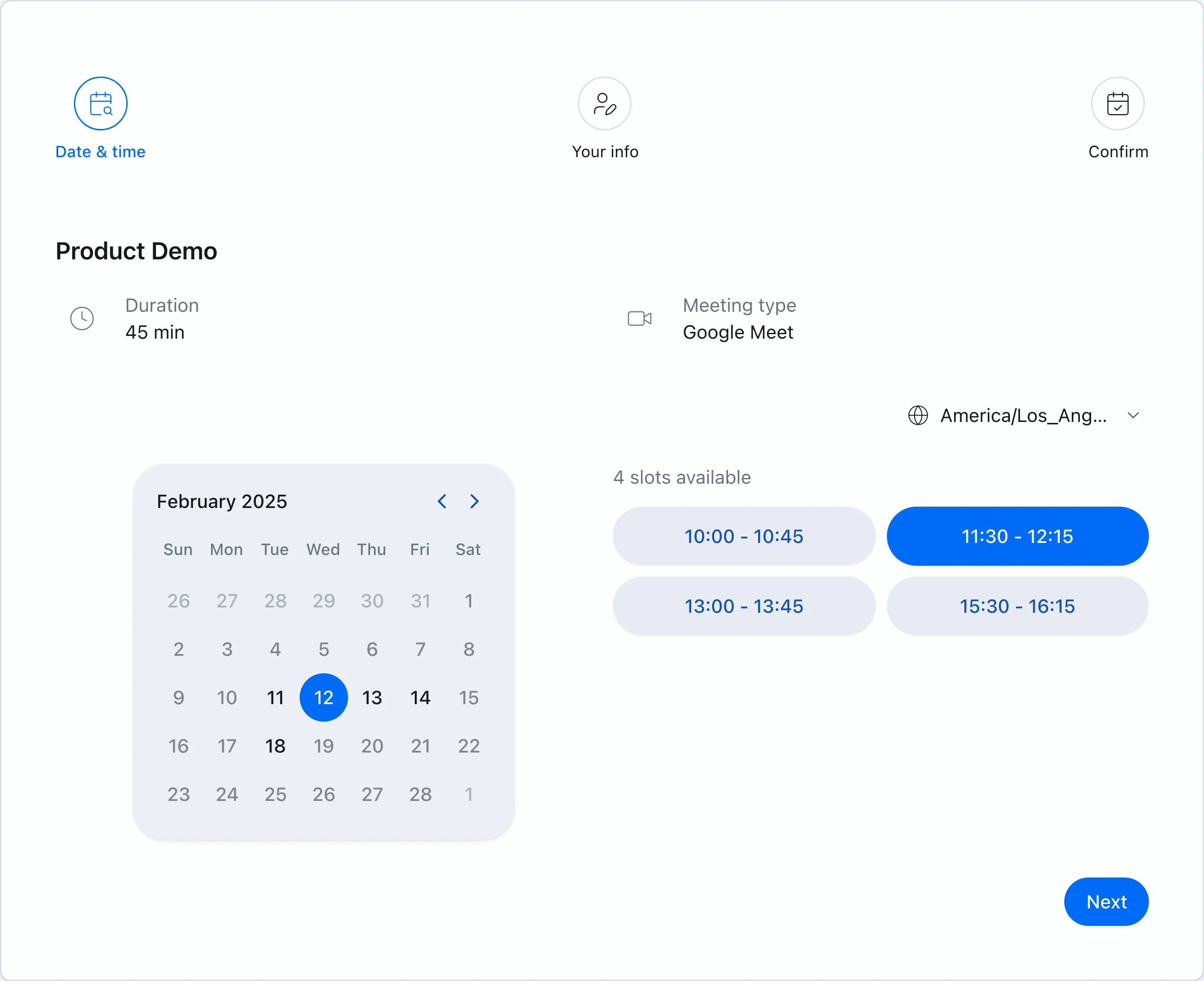 Chronock booking pages show only genuinely available times based on your connected calendars.
Availability across three or more calendars
Where TimeRex connects up to two calendars, Chronock connects multiple Google and Outlook calendars from the Free plan. If you split calendars by role — work, personal, side business — that difference shows up every day.
Calendar-to-calendar sync against double bookings
Chronock lets you create sync rules between calendars — Outlook↔Outlook, Google↔Google, and cross-provider Google↔Outlook. The Free plan includes one one-way, busy-only rule; Pro adds multiple rules, two-way sync, and the option to show titles or descriptions at the destination. You can block time at work without exposing private details.
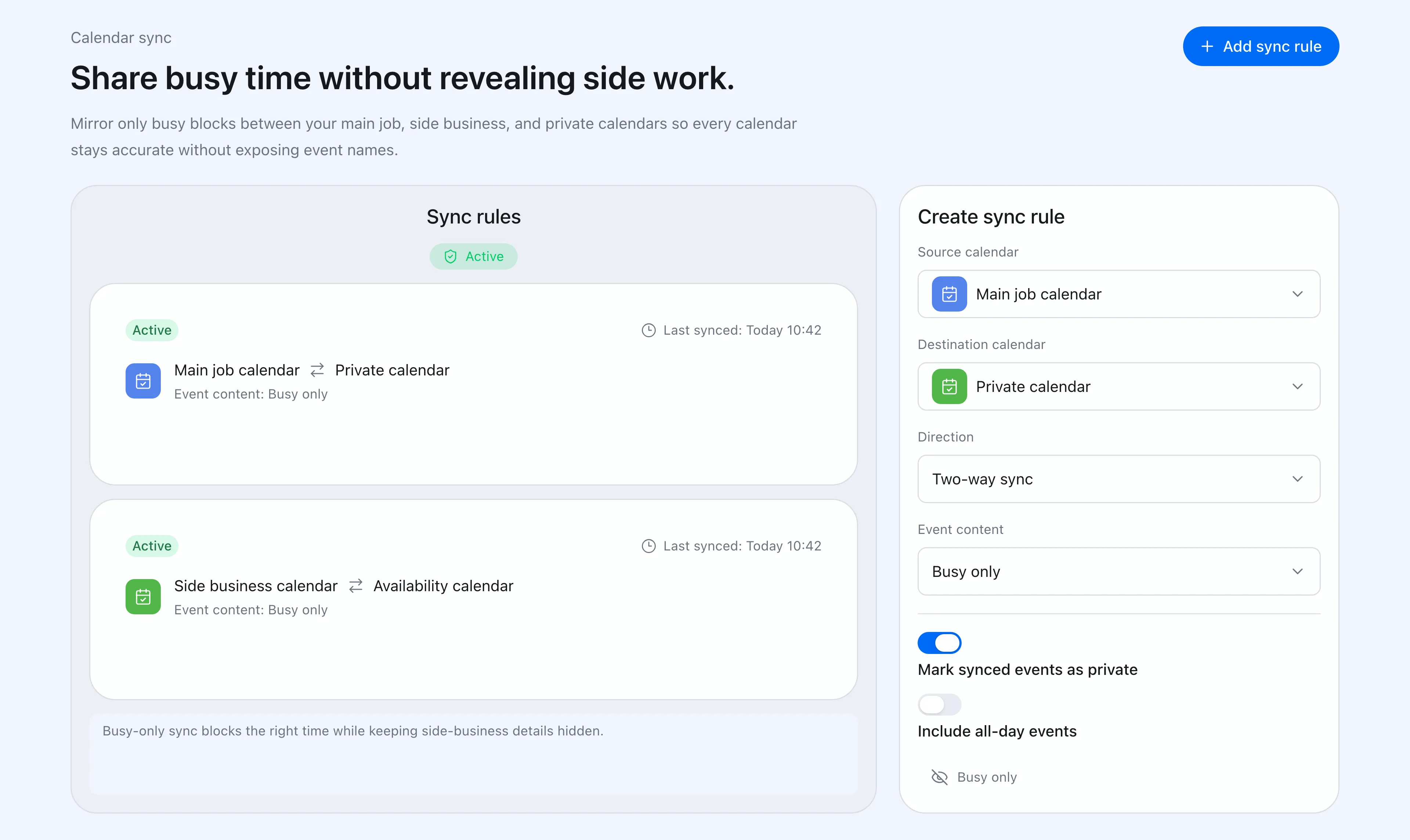 Sync rules control direction and how much event detail reaches the destination calendar.
Candidate times as text
Some conversations work better when you paste a few candidate times into an email instead of sending a link. Chronock’s candidate dates tool builds copy-friendly text from your real availability, and Pro’s provisional holds protect proposed times while you wait for a reply.
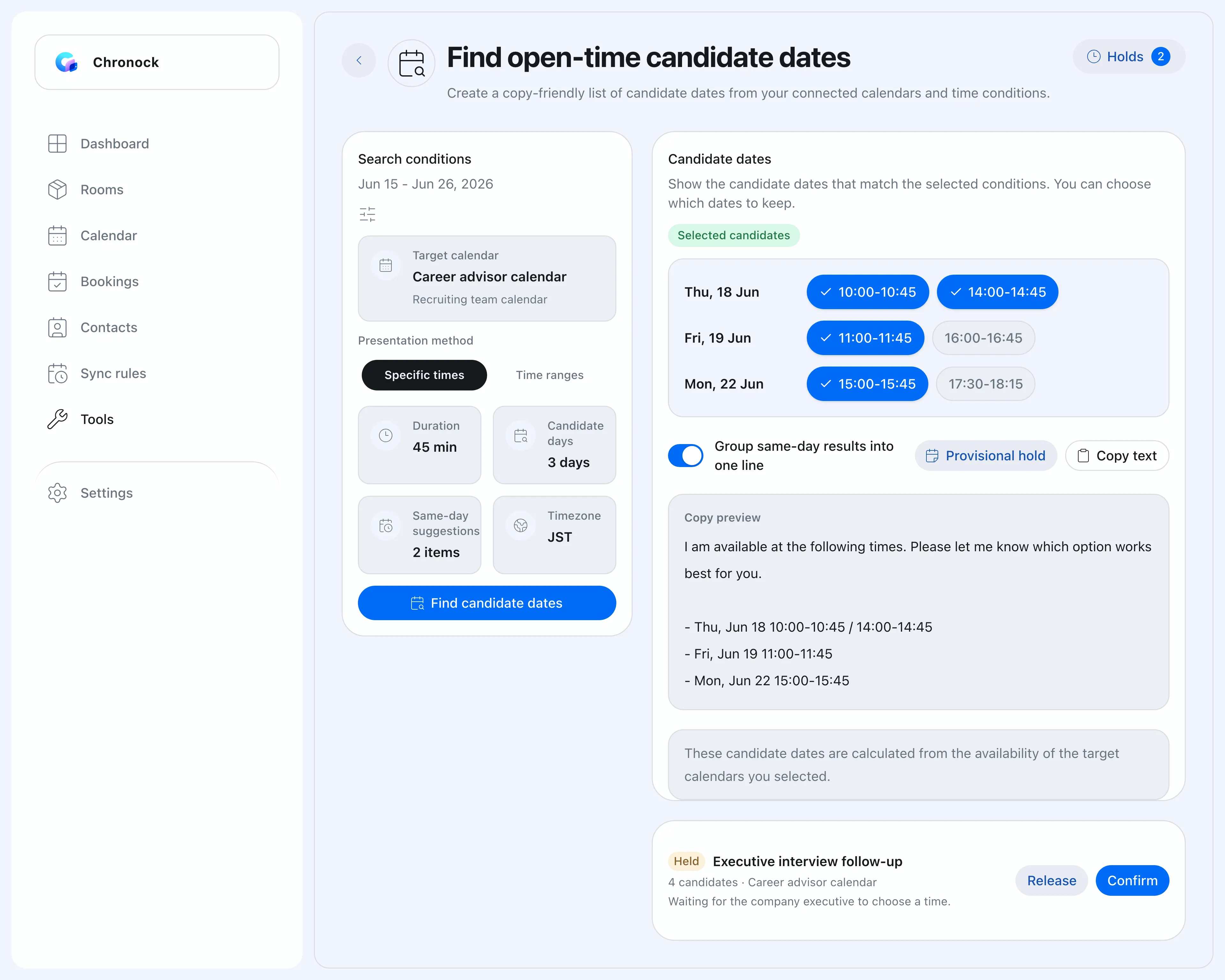 When texting candidate times fits better than a link, you have both options.
Booking history and contacts in the same tool
Chronock Pro includes booking history, contacts, and notes as CRM-style context, so who you met and what comes next lives next to your scheduling.
What to watch with Chronock
Chronock supports Outlook calendars alongside Google Calendar, but with a scope worth checking: Chronock’s Outlook integration works with Microsoft 365 work or school accounts. Personal Microsoft accounts (such as Outlook.com) are not supported due to Microsoft API limitations. iCloud Calendar is not supported either.
Chronock also has no poll-style scheduling like TimeRex’s group polls, and the Free plan includes a single booking slot rather than unlimited ones. If you want many free scheduling links or decide dates by vote, TimeRex fits better.
Before choosing Chronock, check:
- Whether Google Calendar and Outlook (Microsoft 365) cover the calendars you use.
- Whether poll-style scheduling is a must-have.
- Whether one free booking slot covers your needs, or Pro is warranted.
- Whether calendar sync, candidate-time text, and CRM matter to you.
Which should you choose?
| Situation | Easier choice |
|---|---|
| Unlimited free scheduling | TimeRex |
| Outlook Calendar in availability checks | TimeRex, Chronock (Microsoft 365) |
| Deciding dates by group vote | TimeRex |
| Salesforce/HubSpot integration and ad tracking | TimeRex Premium |
| Seminar-style bookings | TimeRex Premium |
| Availability across 3+ calendars | Chronock |
| Calendar-to-calendar sync against double bookings | Chronock (one rule on Free, more on Pro) |
| Candidate times pasted into email or chat | Chronock |
| Booking history and contacts alongside scheduling | Chronock Pro |
Bottom line
TimeRex is a flagship of Japanese scheduling tools: an unlimited free plan, Outlook support, group polls, and serious sales features on the paid tiers. For many individuals and teams, it is simply enough.
Chronock focuses on Google Calendar and Outlook (Microsoft 365) and uses that focus to combine multi-calendar availability, event sync, candidate-time text, and post-booking management at a low price. It suits people who want to lighten their whole calendar operation, not just the scheduling link.
If you want broad free scheduling, pick TimeRex. If you want Google or Outlook calendar scheduling with sync and follow-through, pick Chronock.